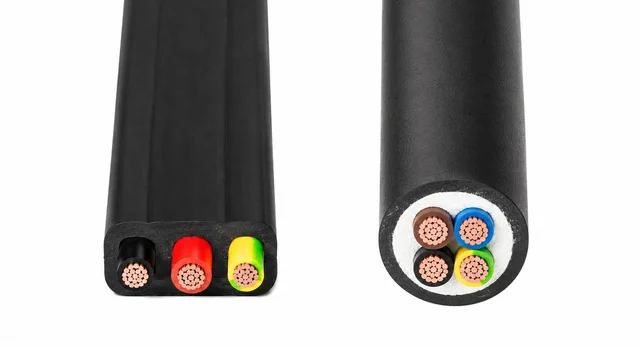
Neither flat nor round submersible pump cable is universally better. Select the profile according to the pump manufacturer’s requirements and the complete installation design. Both are used in underwater pump systems; shape is only one selection criterion.
When comparing flat vs round submersible pump cable, check the pump design and cable entry, borehole clearance, electrical loading, power and protective-earth arrangement, finished dimensions and bending requirements. Water, temperature, chemical exposure, installation and maintenance conditions also affect suitability.
This guide covers water, borehole and wastewater pump cables. Oilfield ESP cables and motor lead extensions serve a different downhole duty involving well fluids, pressure, gas and specialized motor interfaces. A shared flat or round profile does not make these families interchangeable.
What Is a Flat Submersible Pump Cable?
A flat submersible pump cable places insulated conductors side by side in a generally rectangular profile. Three power conductors are one common arrangement, but single-phase systems, separate motor leads and designs incorporating protective earth can require different configurations. Not every flat cable has three cores.
Its relatively small thickness may help a cable pass beside a pump or rising main in a constrained borehole. The advantage depends on orientation: the cable’s width, bends, guards and joints must also fit. A thin cable can still be too wide for the available passage.
Flat construction introduces installation considerations. Bending across the broad face differs from bending edgewise; use the manufacturer’s limits for the actual design. Avoid twisting the cable to force it around an obstruction. Terminations and seals must accept the flat profile. Insulation, sheath and immersion suitability remain construction-specific.
What Is a Round Submersible Pump Cable?
A round submersible pump cable groups insulated conductors within a circular overall construction, potentially using fillers or bedding. A three-phase motor may require three power conductors plus protective earth; other motors and monitoring systems need different layouts. Four cores are not a universal rule.
Round constructions are used in pump systems with compatible round cable entries, including clean-water and wastewater equipment. A circular sheath can fit a specified gland, but the finished diameter, tolerance, compound and sealing instructions must match that entry.
Check routing through bends, supports and enclosures against the documented bend radius and handling limits. A round profile does not inherently establish greater flexibility, durability or water resistance. Custom layouts may combine power, protective earth and monitoring conductors, subject to dimensions and engineering confirmation.
Flat vs Round Submersible Pump Cable: Key Differences
Compare the offered constructions rather than assuming shape defines performance. On small screens, scroll the table horizontally to read both profiles.
| Selection point | Flat pump cable | Round pump cable |
|---|---|---|
| Cross-sectional profile | Broad, relatively thin profile | Circular overall profile |
| Core arrangement | Usually side-by-side insulated cores; count varies | Grouped cores; count and internal layout vary |
| Installation clearance | Check width, thickness and installed orientation | Check outside diameter and accessory envelope |
| Cable entry compatibility | Needs a compatible flat entry or approved transition | Needs the specified diameter and seal compatibility |
| Routing and bending | Facewise and edgewise limits may differ | Follow the actual construction’s bend and movement limits |
| Mechanical protection | Protect broad faces, edges and clamped sections | Protect against abrasion, crushing and clamp damage |
| Insulation and sheath options | Materials selected for electrical and fluid duty | Materials selected for electrical and fluid duty |
| Electrical performance | Calculate for conductor size, layout and installation | Calculate for conductor size, layout and installation |
| Termination requirements | Profile-compatible seals and core preparation | Diameter-compatible seals and core preparation |
| Typical applications | Constrained boreholes and compatible deep-well systems | Compatible borehole, drainage and wastewater systems |
| Customization options | Core count, size and layers within geometry limits | Power, earth and sensor layouts within diameter limits |
| Cost considerations | Compare materials, processing, accessories and quantity | Compare materials, processing, accessories and quantity |
Cable shape alone does not determine current-carrying capacity, voltage drop, rated voltage, temperature rating, immersion suitability, chemical resistance, service life or final procurement cost. These depend on the complete cable construction and specified operating conditions. Include joints and installation work when comparing quotations.
Which Cable Is Better for Deep Wells and Boreholes?
Start with the available pump-to-well clearance and the actual cable route. Compare flat cable width and thickness, or round cable outside diameter, with the pump, rising main, cable guards and installation hardware. Allow for dimensional tolerances and larger joint sections.
A suitable low-profile flat design can help where radial space is limited and the cable can maintain its intended orientation. It is useful only if the width, entry, protection and bending requirements also fit. A round cable remains an option where the OEM permits it and clearance is adequate.
Plan vertical cable support, permitted pulling loads and attachment points according to the installation instructions. Protect the sheath while lowering the assembly; assess abrasion, snagging and retrieval as well as initial insertion.
Do not use the power cable to support the pump’s weight unless the complete system is specifically designed and approved for that duty. Arrange pump suspension and cable support as defined by the pump manufacturer.
Which Cable Is Better for Sewage and Wastewater Pumps?
For sewage pumps, the manufacturer’s cable-entry and sealing arrangement often narrows the profile choice. Confirm the specified cable dimensions and replacement procedure before considering an alternative.
Next assess handling, abrasion against structures, debris and maintenance access. Specify continuous versus intermittent immersion, fluid temperature, wastewater contaminants and cleaning chemicals, including concentrations where known. Select a jacket compound with evidence for that exposure; “rubber” or “oil-resistant” is not a complete wastewater specification.
Check sensor and monitoring circuits alongside motor power. Thermal protection or leakage monitoring may need additional cores, identified circuits and suitable separation or screening. Material and construction suitability matter more than shape alone.
Cable Materials: PVC, Rubber, EPR and Other Options
Insulation surrounds individual conductors and provides electrical separation. The outer sheath, or jacket, protects the assembled cable from its environment and handling. They perform different roles and may use different compounds.
PVC and specified rubber or elastomer systems appear in pump-cable designs. Elastomer constructions may be selected where bending and handling requirements justify them, but formulation, stranding and layer dimensions also affect performance. EPR refers to ethylene-propylene rubber insulation terminology; it is not a complete sheath specification. The EPR, EPDM and HEPR insulation guide explains these distinctions.
A material label alone does not establish continuous-immersion suitability. Confirm fluid compatibility, immersion depth and duration, temperature and the integrity of joints and entries for the exact product. Do not transfer a material family’s temperature or service-life claim to a finished cable.
Likewise, H07RN-F should not automatically be accepted for continuous underwater operation. Require product-specific documentation for the proposed duty. For comparison, LAPP’s H07RN8-F documentation explicitly defines immersion conditions and application restrictions for that product. Its limits do not qualify a different cable or a DEV CABLE construction.
Potable-water service may require additional application-specific approvals in the destination market. Confirm that documentation covers the supplied construction and water-contact accessories.
How to Choose the Correct Submersible Pump Cable
- Confirm the pump model and wiring diagram. Identify the motor, connection arrangement and OEM cable requirements.
- Confirm voltage, current and motor duty. Include phase, frequency, starting method and any variable-frequency drive requirements.
- Check the complete cable route and length. Include the surface run, submerged section and joints. Assess current capacity and running/starting voltage drop under the relevant installation conditions.
- Confirm installation clearance and cable entry. Compare finished dimensions, tolerances, bends, guards and seal requirements.
- Determine the conductor arrangement. Define power conductors, protective earth and any control or sensor cores from the wiring diagram.
- Specify immersion depth, duration and fluid. Include pressure conditions where relevant, contaminants and cleaning exposure.
- Select insulation and sheath requirements. Define electrical, thermal, chemical and mechanical duty separately.
- Confirm terminations and protective measures. Review joints, gland seals, strain relief, cable support and installation protection together.
- Define testing and required documentation. Agree the construction drawing, datasheet, applicable standards, inspection scope and required reports before ordering.
Use motor-specific sizing guidance, such as the applicable frequency/version of Franklin Electric’s AIM manuals, where relevant to the installed motor. A generic cable-size chart cannot cover every route, starting method and thermal condition.
Illustrative example: a borehole assembly has restricted radial clearance but enough width beside the rising main. An OEM-permitted flat design could fit after the guard and joint dimensions are checked. A different pump has a specified circular cable entry; a compatible round construction could be required even when a flat cable has the same conductor size. These are hypothetical selection scenarios, not reported customer projects.
Can You Replace a Flat Pump Cable with a Round Cable?
Only when the proposed replacement meets the complete system requirements and approved pump-manufacturer instructions. Matching conductor cross-section alone is insufficient.
Verify electrical compatibility, conductor identification and protective earth, plus clearance along the full route. Check cable-entry and seal compatibility, joint and termination design, and required immersion and environmental ratings. A round gland should not be improvised to grip a flat sheath. Any profile transition requires an approved arrangement suitable for its location.
Record the accepted replacement construction and installation procedure so future maintenance does not rely on an assumed equivalence.
How to Specify a Custom Submersible Pump Cable
DEV CABLE can review custom submersible pump cable constructions against supplied pump and installation data. Include these details in an RFQ:
- Pump manufacturer, model and wiring diagram.
- Application: borehole, clean water, sewage or another defined fluid service.
- Supply voltage, motor current, phase, frequency and starting method.
- Required cable length, including surface and submerged sections.
- Flat or round profile; number and size of power conductors.
- Protective-earth requirements and conductor identification.
- Sensor or monitoring cores, circuit assignments and screening needs.
- Maximum permitted dimensions, tolerances and installation clearance.
- Immersion depth and duration; water or fluid composition.
- Fluid, ambient and conductor-temperature requirements.
- Insulation and sheath requirements, including chemical exposure.
- Cable-entry drawings, seal dimensions, joints and termination details.
- Required standards, tests, approvals and documentation.
- Quantity, cut lengths, packing requirements and destination country.
For integrated monitoring, review submersible pump cable with control and sensor cores. Confirm feasibility, finished dimensions, ratings and supply scope on the agreed design sheet. Custom capability does not establish stock availability or approval of every requested configuration.
Frequently Asked Questions
Is flat submersible pump cable better than round?
Neither is universally better. A suitable flat cable may help with restricted radial clearance; a round cable may match a specified pump entry. Select against the complete installation requirements.
Can round cable be used in a borehole pump?
Yes, where the pump manufacturer permits it and the cable, joints and guards fit the route. Confirm electrical duty, immersion suitability, bending and support requirements as well.
Can flat and round pump cables be interchanged?
Only after confirming electrical, mechanical, sealing and environmental compatibility under the OEM instructions. Equal conductor size does not establish interchangeability.
Does a round cable provide better waterproofing?
Shape alone does not determine water resistance. The construction, fluid duty, intact sheath, cable ends, joints and motor-entry seals determine suitability for the specified immersion conditions.
How do I determine the correct cable size?
Use motor current, voltage, full route length, starting method, installation conditions and allowable voltage drop. Follow applicable OEM guidance and electrical requirements; confirm both conductor size and finished cable dimensions.
Can submersible pump cables include sensor cores?
Yes, project-specific constructions can include monitoring conductors. Define the sensor circuits, identification and screening requirements, then confirm electrical separation, dimensions and entry compatibility.
Conclusion: Choosing the Right Cable
Choose the profile that meets the pump’s entry and installation clearance, then verify electrical sizing, conductor arrangement, materials and immersion duty. Compare documented constructions and compatible accessories before accepting a substitute.
Provide the pump specification, wiring diagram, dimensional limits and operating conditions for a project-specific assessment. The existing quotation options below let you send those details to DEV CABLE for construction review.